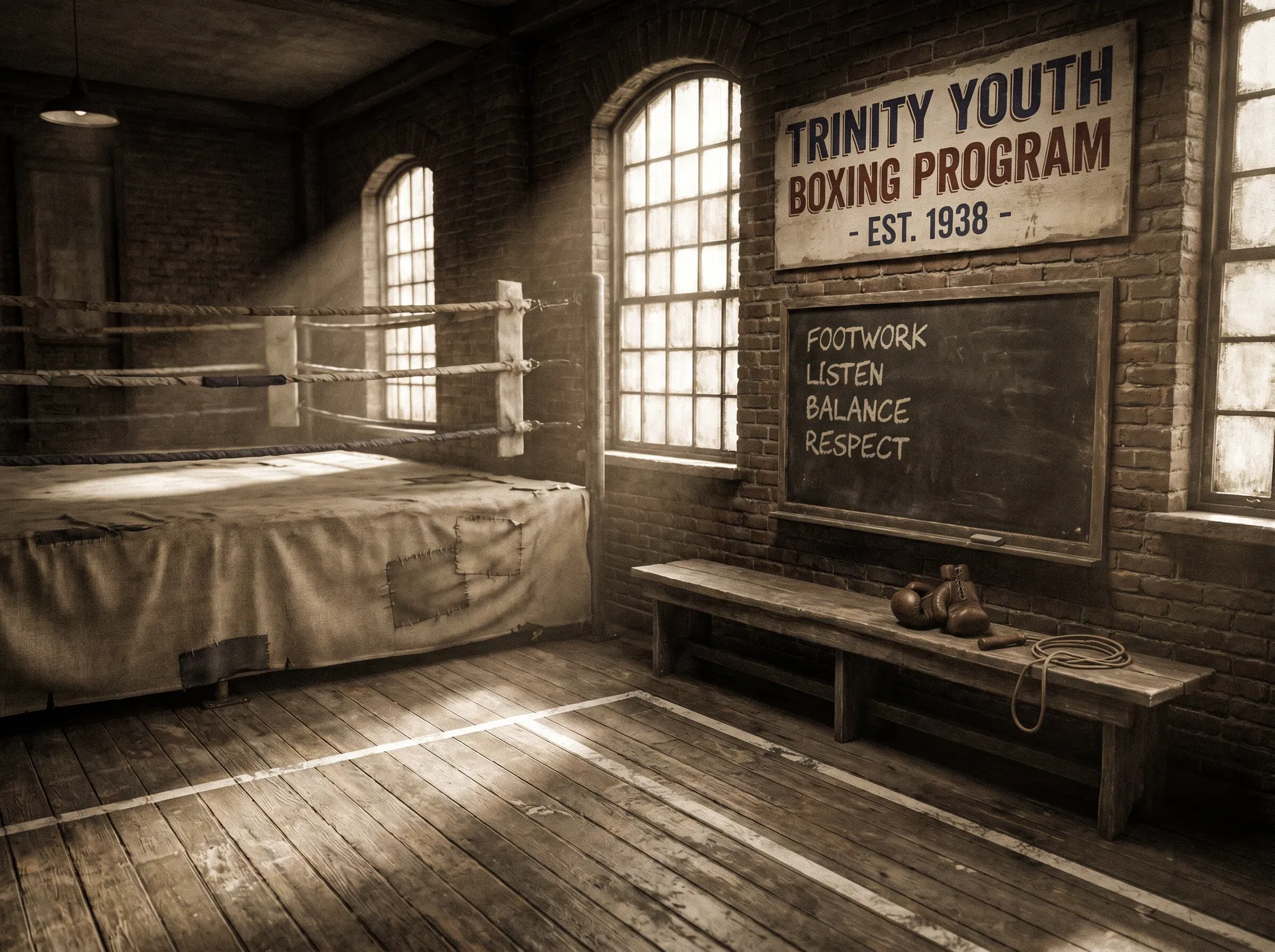
Rough vintage Trinity youth boxing room for Kids Mind Training
Parents · Young Athletes · Calm Under Pressure

Kids Mind Training

The adult Mind work is about Jung, Cus D'Amato, fear, Shadow, and the person inside the fighter. This is the youth version: courage without cruelty, confidence without arrogance, and a child learning how to stay calm when pressure starts talking.

For The Parents

We are not building little maniacs. We are building calm, capable kids.

Parents do not bring children to Trinity because they want a house full of tiny prizefighters shadowboxing at the dinner table. They bring them because the world is loud, screens are louder, confidence is fragile, and a child needs a place where effort, respect, courage, and listening still mean something.

Kids Mind Training takes the deeper Jung and D'Amato material and translates it into youth work. Fear becomes something a child can name. The Shadow becomes big feelings that need rules. The Persona becomes the difference between brave posture and fake toughness. Visualization becomes a simple rehearsal. The corner becomes the trusted voice a child can find when the room gets noisy.

Six Parent Rounds

Jung And D'Amato, Cut Down To Kid Size Without Dumbing It Down.

I

For Parents

Fear Is Not Failure

A nervous kid is not broken, weak, or soft. A nervous kid is a human being with a loud alarm system. Cus D'Amato understood fear as something to use, not something to insult. That is the first lesson: fear can be named, breathed through, and put to work.

For the young athlete: say the fear, take the breath, put the hands up, and do the next simple job. Nobody wins the whole round at once.
II

Big Feelings

The Shadow Gets Rules And Footwork

Jung had a word for the stuff people hide from themselves: the Shadow. Kids have shadows too, only they usually call it anger, embarrassment, jealousy, quitting, showing off, or melting down when the drill gets hard. We do not shame the kid for having the feeling. We teach the feeling where to stand.

Bad feelings do not make a bad kid. They need words, structure, a coach, and enough footwork that the body learns another answer besides panic.
III

Confidence With Manners

The Fighter Mask Comes Off

Jung called the social mask the Persona. Boxing gives a child a useful version of that mask: hands up, eyes forward, brave posture, serious effort. But Trinity makes the second half clear. The fighter belongs in the work. The decent kid goes home after class.

Be fierce in the drill and kind when the bell stops. Gloves are not permission to act like a fool. They are a uniform for a serious job.
IV

Visual Rehearsal

Seeing The Round Before It Starts

Active imagination sounds like it needs a library and a pipe. It does not. A child can rehearse a drill before doing it: picture the stance, hear the coach, see the first mistake, recover from it, and keep moving. That is not daydreaming. That is preparation.

For the young athlete: see the jab, see the slip, see yourself miss once and come back. The mind gets a practice round before the body steps in.
V

The Corner

Listening When The Room Gets Loud

Pressure makes children stop hearing. Adults too, if we are being honest in church. The corner teaches a child to find one trusted voice in a loud room and follow one correction at a time. Breathe. Hands up. Step back. Try again.

The lesson is not obedience for its own sake. It is self-command: learning how to receive help when emotions are trying to run the show.
VI

The Point

Strong Hands. Quiet Mouth. Honest Effort.

The goal is not to manufacture little tough guys. The world has enough of those and most of them need a nap. The goal is a calmer, braver, more respectful kid who can stand in a room, try something hard, listen to correction, and leave with a little more confidence than they came in with.

That is Kids Mind Training at Trinity: courage without cruelty, confidence without arrogance, and pressure handled one round at a time.

What Parents Can Expect

A Young Athlete Who Can Breathe, Listen, Try Again, And Keep His Or Her Manners.

This is not a promise that boxing fixes everything. Anyone selling that should be made to run stairs. It is a promise that the room can teach a child how to meet hard feelings with structure and hard work with dignity.

Talk To The Corner
What We TrainCalm breathing, listening, imagination, focus, safe competitiveness, self-command, and recovery after mistakes.
What We AvoidNo tough-guy nonsense, no shaming fear, no turning boxing into permission for arrogance.
What Parents Should SeeA child who stands better, listens sooner, handles correction cleaner, and begins to trust effort over mood.
How It ConnectsThe same Jung and D'Amato ideas from the adult Mind work, translated into parent-safe language and kid-sized drills.

Parent FAQ

Straight Answers Before You Put Your Kid In The Room.

Parents should ask questions. That is their job. Our job is to answer plainly and run a room where kids learn courage, manners, effort, and control without turning boxing into theater or trouble.

?

Martin-Style Answer

Is this teaching my kid to fight in school?

No. If a kid leaves Trinity thinking gloves give him permission to act like a tough guy, we failed the kid and the house. The work teaches control first: hands to yourself, mouth shut when needed, eyes up, breathe, listen, and use boxing for discipline, not trouble.

?

Martin-Style Answer

My child is anxious. Is boxing too much pressure?

Pressure is not the enemy when it is introduced with care, rules, and a coach watching the room. We do not throw a nervous child into the deep end and call it character. We give the child small jobs, honest encouragement, and a way to recover after mistakes.

?

Martin-Style Answer

Will this make my kid tougher?

It will make the right kind of toughness if the child does the work. Not loud toughness. Not bully toughness. Steady toughness. The kind where a kid can hear correction, take a breath, try again, and not fall apart because one round got uncomfortable.

?

Martin-Style Answer

What if my child is being bullied?

We teach presence, boundaries, confidence, and self-command. A child who stands better, speaks clearer, and carries himself or herself with calm is already less alone in the world. We do not sell revenge fantasies. We teach a kid to become harder to shake and easier to respect.

?

Martin-Style Answer

Is the Jung and D'Amato material too heavy for kids?

Not the way we teach it. We do not hand a ten-year-old a psychology lecture and ask him to explain the Shadow. We say: big feelings need rules, fear needs a breath, imagination can practice the round, and the corner voice can help when the room gets loud.

?

Martin-Style Answer

What should parents look for after a few weeks?

Look for small honest changes: better posture, cleaner listening, less panic after a mistake, more patience with correction, and a little more pride in effort. Boxing is not magic. But a good room, repeated the right way, can put a better rhythm into a child.

The Youth Translation

Strong Hands. Quiet Mouth. Good Eyes. Honest Effort.

The point is not to scare the fear out of a child. The point is to teach the child what to do when fear walks in and starts running its mouth.